



Marginal Revenue Vs. Marginal Cost (MR>MC)
Every Day You Are - Presented With opportunities to invest your money and the key strategy is putting your money to work where it will earn you the most bottom line profit and increase your cash flow.
What Are Opportunities? - Tools, equipment, vehicles, software, outsourcing, real estate anything you could use in your business that has the potential to increase revenue or reduce expenses.
Some Opportunities - Are worthwhile and some are not. The answer is having a system to quickly and easily determine which opportunities to pursue and which ones to ignore.
Do Not Trust Your Gut - It may sound strange but your gut will lead you down the path of mediocrity or destruction depending on the size of the investment. The reason is there are far too many variables to consider and here are seven of them to get you started:
-
Have you calculated your company's current hurdle rate?
-
Is it a simple one-time investment?
-
Is it a large purchase with a down payment and subsequent monthly payments?
-
Does it require monthly or annual maintenance contracts?
-
Have you completed present value calculations?
-
Have you calculated the Internal Rate of Return (IIR)?
-
Have you considered discounted cash flows?
Complex Decision Modeling - And statistical analysis is best; however, for a construction company with annual revenues under $5,000,000 it is overkill, similar to hunting house flies with a sledge hammer.
We Have Simple - Tools to help our clients make intelligent informed decisions on which opportunities to accept and which ones to reject.
For Any Opportunity Give Us Six Pieces Of Information:
-
The initial cost of the tool, equipment, service or item?
-
If it is financed what are the payment terms?
-
The monthly or yearly maintenance cost if any?
-
How long you expect the tool, equipment, service or item will last in terms of weeks, months or years?
-
How many minutes, hours or days of labor it will save in a week or month?
-
The hourly base pay of the person that will be benefit from the tool, equipment, service or item?
From The Information - Provided and some reports we can get from your Properly Setup QuickBooksfile we can generate a simple analysis you can use to make an intelligent informed decision.
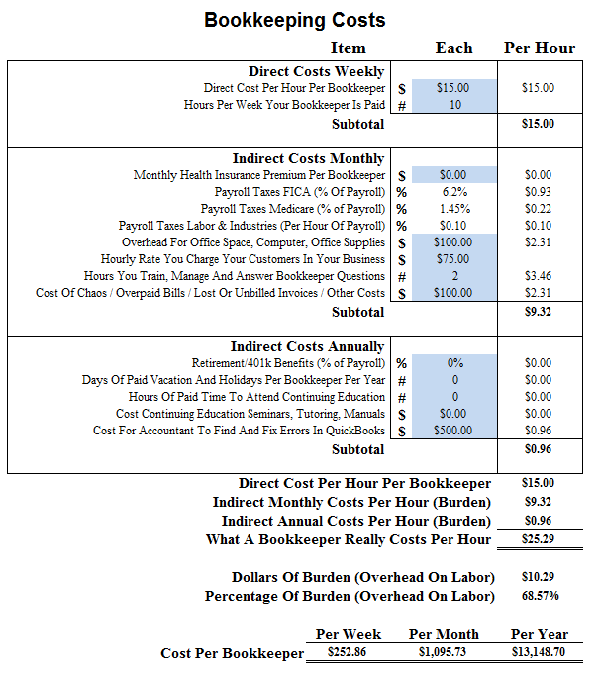
Dual Monitors Example Adds $3,287.16 To The Bottom Line!
-
An in-house or outsourced bookkeeper has only one 19" computer monitor
-
The tiny numbers are hard to see which causes eye strain
-
The bookkeeper is wasting 30 minutes a day due to poor equipment
-
Every year this construction company wastes $821.79 in bottom line profits and cash flow!

The Solution
Invest in dual 27" DVI monitors for an estimated cost of $600.00
-
The first year added bottom line profit and cash flow is $162.00
-
Total added bottom line profit and cash flow over five years is $3,287.16
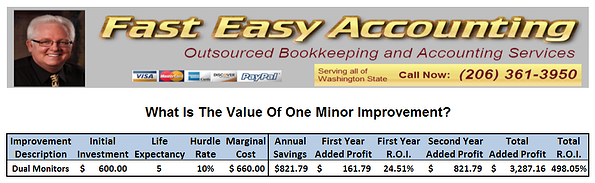
Increase Sales Or Reduce Costs - The two main drivers of profit. Best practices from successful construction companies show they do both. The key is a thorough analysis on a case-by-case basis for each opportunity.
The Example Shown Above - Should take about fifteen minutes if your QuickBooks is properly setup and maintained so that it generates accurate useful reports.
If Your QuickBooks - Is not generating accurate reports contact us immediately because most business failures can be traced back to a lack of Key Performance Reports and bad bookkeeping.
----------------------------------------------------------
Why Some Construction Companies Earn Obscene Profits!
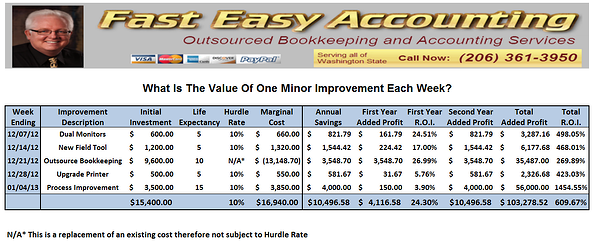
Success Is A Few Simple Disciplines Practiced Every Day - The construction companies that make a lot of money regardless of the economy, competition or any other external distraction are the ones that practice C.A.N.E.I. Continuous Never Ending Improvement. The example below shows a fictional sample construction company that makes one minor improvement every week.
For Construction Company Owners who do not need the full power of QuickBooks for contractors and want 24/7 online access we offer Xero Accounting Online and we have custom setup for construction companies. Click Here For More.
We Remove Contractor's Unique Paperwork Frustrations
This Is One More Example of how Fast Easy Accounting is helping construction company owners just like you put more money in the bank to operate and grow your construction company. Construction accounting is not rocket science; it is a lot harder than that and a lot more valuable to people like you and me so stop missing out! Call Sharie 206-361-3950 or sharie@fasteasyaccounting.com and schedule your no charge one-hour consultation

Profitable Contractors and Construction Company owners have known about the value of outsourced bookkeeping services and contractor coaching services like ours for a long time and now you know about it too!
We Scan Your Receipts And Invoices link the appropriate transactions to QuickBooks or Xero Accounting Online depending on the construction accounting service you are using and provide ongoing Cloud Based Contractors Bookkeeping Services by accountants who understand construction.
Our Contractor Bookkeeping Services System Is A System
Thinking About Outsourcing Your Contractors Bookkeeping Services?
Click On The Button Below To Download A Free Guide

Business Process Management (BPM) For Contractors
Fill Out The Form And Get The Help You Need!
Need Help Now?
Call Sharie 206-361-3950
sharie@fasteasyaccounting.com
Xero Outsourced Construction Accounting Services
QuickBooks Outsourced Construction Bookkeeping Services
We Are QuickBooks Experts Specializing In Construction Bookkeeping Services
About The Author:
 Randal DeHart, PMP, QPA is the co-founder of Business Consulting And Accounting in Lynnwood Washington. He is the leading expert in outsourced construction bookkeeping and accounting services for small construction companies across the USA. He is experienced as a Contractor, Project Management Professional, Construction Accountant, Intuit ProAdvisor, QuickBooks For Contractors Expert and Xero Accounting Specialist. This combination of experience and skill sets provides a unique perspective which allows him to see the world through the eyes of a contractor, Project Manager, Accountant and construction accountant. This quadruple understanding is what sets him apart from other Intuit ProAdvisors and Xero accountants to the benefit of all of the construction contractors he serves across the USA. Visit http://www.fasteasyaccounting.com/randal-dehart/ to learn more.
Our Co-Founder Randal DeHart - Is a Certified PMP (Project Management Professional) with several years of construction project management experience. His expertise is construction accounting systems engineering and process development. His exhaustive study of several leading experts including the work of Dr. W. Edward Deming, Michael Gerber, Walter A. Shewhart, James Lewis and dozens of others was the foundation upon which our Construction Bookkeeping System is based and continues to evolve and improve. Check out our Contractor Success Map Podcast on iTunes and Follow Randal on Google+
Our Co-Founder:
 Sharie DeHart, QPA, is the President of Business Consulting And Accounting (Fast Easy Accounting) in Lynnwood, Washington. She is the leading expert in managing outsourced construction bookkeeping and accounting services companies and cash management accounting for small construction companies across the USA. She encourages Contractors and Construction Company Owners to stay current on their tax obligations. She offers insights on managing the remaining cash flow to operate and grow their construction company sales and profits so they can put more money in the bank. Call 1-800-361-1770 or sharie@fasteasyaccounting.com.